Safety in Numbers
From mathematics to cybersecurity, Oluwatobiloba Mercy Akinwunmi is leading the way to a safer digital-first world
News > Oluwatobiloba Mercy Akinwunmi
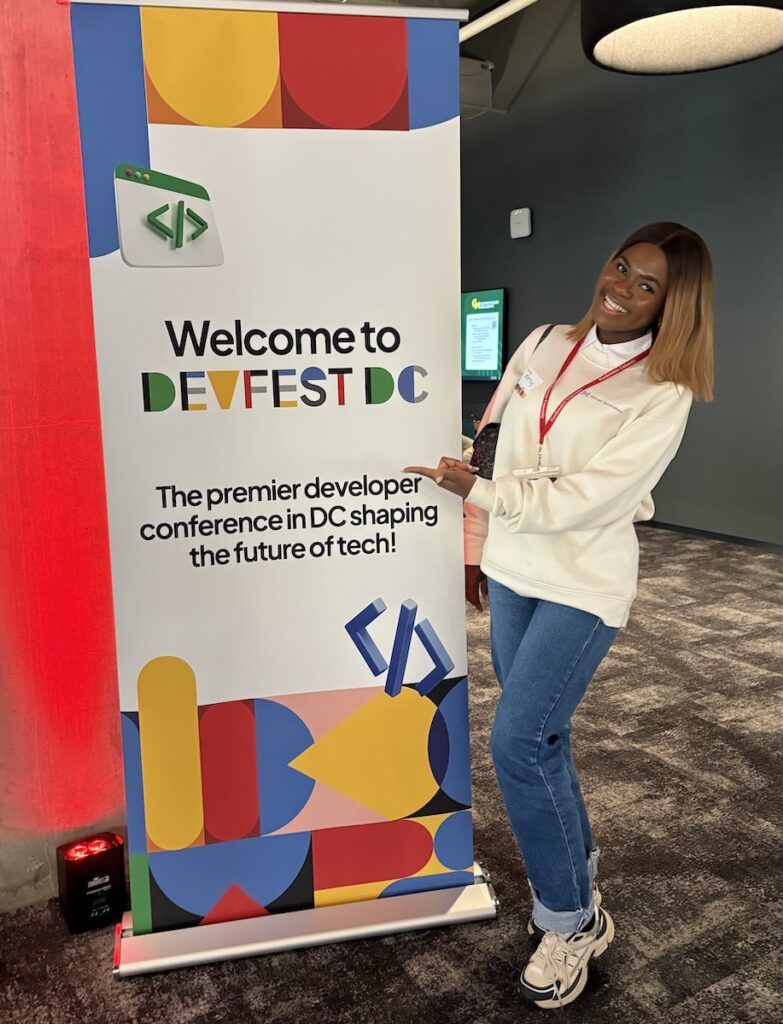
by Rebecca Moon Ruark
An online scam that negatively impacted her family—emotionally and financially—first piqued Oluwatobiloba Mercy Akinwunmi’s interest in cybersecurity. “My dad was a victim of an online scam when I was in high school, and it helped me to understand that cybercrime is not just a technical issue,” she said. “It affects real people and real families.”
Looking back, that personal experience influenced her interest in social engineering attacks and even the direction of her research as a student in the Master’s in Cybersecurity program at Northeastern in Arlington. Her recent project, “Scam and Extortion Message Detection,” began as an assignment for CY 50001, Intensive Foundations of Computer Science. Her goal? Develop a system to flag the spam and scams—from extortion to phishing language—that cause financial and emotional harm to millions of individuals each year.
Developing a system to stop scams at the start
“Cybercriminals use urgency, financial threats, and impersonation to manipulate victims into complying with fraudulent demands,” Akinwunmi notes, in executing engineering attacks that account for “a significant proportion of successful security breaches annually.”
Teaching professor and director of computing programs Huihui Wang provided Akinwunmi with mentorship. Akinwunmi developed a rule-based cyberthreat detection system to perform keyword scoring using Python, which offers transparency and low computational cost but cannot adapt to evolving scam language. The Python-based system gave her a baseline, but she was just getting started.

Akinwunmi developed her research project further for CY 5010, Cybersecurity Principles and Practices, led by Elizabeth Hawthorne, teaching professor and director of the cybersecurity graduate program, as well as a trailblazer for women in cybersecurity. “This time I wanted to try something different,” said Akinwunmi, who added a machine learning (ML) element to her scam detection project in an attempt to, in simple terms, “use AI to beat AI at scams.”
Of course, the process wasn’t simple. She added Naive Bayes and Logistic Regression classifiers trained on AI to see if the models meaningfully improved scam and extortion detection accuracy and reduced false positives compared with her rule-based scoring baseline. They did, “to almost 90 percent accuracy,” she said, with Naive Bayes outperforming all approaches with 98.69 percent accuracy detecting scam and extortion messages. Another takeaway from the two-phase project: “They’re working hard, these scammers, so we have to work harder.”
Building on a strong foundation
While in high school back home in Nigeria, Akinwunmi was introduced to coding, AI, and robotics, by a cousin who worked in IT. Building on that early interest in tech, Akinwunmi pursued her undergraduate degree in pure and applied mathematics from the University of Lagos. Two scholarships helped her find her way to Northeastern’s Align program, which gives students without a background in computer science a direct path to a Master of Science in computer science, data science, artificial intelligence, or cybersecurity.
As an undergraduate, Akinwunmi received a scholarship to attend a Women in Cybersecurity (WiCyS) conference in the U.S. and sit for the foundational GIAC cybersecurity practitioner certifications. After earning her certifications, and impressed with the evolution of cybersecurity in the U.S., she returned to Nigeria to finish her undergraduate program with her sights set on pursuing her master’s in the discipline. While transitioning from a math background to cybersecurity felt like a “big leap,” her “analytical background laid the groundwork” for her cybersecurity journey.

Finding her way to the Khoury College of Computer Sciences was more than a coincidence—but rather an act of “grace,” according to Akinwunmi. Using a grant she received for graduate school from the Information Systems Audit and Control Association, she funded her travel to return to the U.S. on scholarship for her second WiCyS conference. On the lookout for the right graduate program, Northeastern hadn’t been on her radar. But when she came across it at the conference career fair, “everything clicked,” she said.
Northeastern’s Align program sounded like the perfect fit for Akinwunmi. “The Align program felt like it was designed for someone exactly like me, coming from a mathematics background,” she said. “I wanted a program that that could combine strong technical education, with practical—and inspirational—learning.”
“The Align program stood out because it emphasized end-on-end security, application, collaboration, and rewarding impact. It felt like the right door opened at exactly the right time.”
Future-forward
With a taste for research, Akinwunmi hopes to continue working as a “purple teamer,” as Hawthorne would put it—one who understands both red (malicious) actors and blue (defensive) positions to best protect networks and systems from threats. Adding to Akinwunmi’s cybersecurity skillset, this summer she is taking a course on digital forensics and application program interface threats and is writing another cybersecurity certification. In addition to her studies, she is working on campus as an IT/AV support assistant and is interning with the Cyber Security Summit, bridging her academic work with real-world experience.
As for after graduation, Akinwunmi is interested in work that combines server security with intelligent detection systems. “I hope to contribute to building accessible server security solutions that not only improve security but also educate and protect vulnerable users,” she said. “Cybersecurity is not just technical work; it is human work. It’s about protecting people, enabling trust, and ensuring safety in a digital-first world.”

She also hopes to continue growing as a leader, mentor, and advocate within the cybersecurity community, and an active ambassador for women in cybersecurity. Akinwunmi serves as the founding president of the WiCyS Northeastern–Arlington Student Chapter, “one of the most meaningful parts of my journey here,” she said.
With a strong platform online and off, she is a Google Women Techmakers Ambassador, advocating for diversity, visibility, and empowerment in tech. And she founded the Cyber Connect community, dedicated to helping newcomers break into cybersecurity, through mentorship, resources, and hands-on learning. “My goal is simple,” she said—“to help others grow, just as many have supported me.”