Makaita Murogodo demonstrates why everyone benefits from women in cybersecurity
News > Makaito Murogodo

by Madelaine Millar
Makaita Murogodo has always known she’s as good at computer science as her male peers. But sometimes, she felt like the only one who knew it.
“I’m from Zimbabwe. I’ve seen roles where they tell you all the responsibilities and qualifications, but then at the end they tell you a male applicant is preferred,” she said. “There’s a belief that a woman has a lot of responsibilities at home – you should be there being a wife, being a mother. This technical role is not for you.”
Now in the second year of her MS in Cybersecurity degree at Northeastern University Arlington, Murogodo was tired of making the case for her own competence. So when Professor Elizabeth Hawthorne assigned her class a research project for the Arlington campus’s upcoming Student Research Showcase, it was the perfect opportunity for Murogodo to explore whether the diverse threat perspectives of mixed-gender teams could actually make cybersecurity more resilient.
The security risks of homogenous teams
“Most people were doing more technical projects, and then there was me with something non-technical, but it just felt closer to home,” Murogodo said. “I wanted to show that we are misrepresented, and we deserve the same seat as men deserve.”
Drawing heavily on ISC2 workforce studies, Murogodo found that women represent only about 24 percent of the modern cybersecurity workforce – less at higher levels – and face barriers to entry, retention, and career progression. But the women being excluded weren’t the only ones suffering from their exclusion. Murogodo also learned that gender-diverse cybersecurity teams experienced more effective collaboration and problem-solving, better retention, and detected a wider range of threats than single-gender teams. She estimates the performance improvement among gender-diverse teams could be as high as 36 percent.
“The research that I was looking at shows that when a company has diversity, women and men think differently, and if you have a team combining both, they cover one another’s blind spots,” Murogodo said. “When we come together, we come up with solutions that help us be a better team.”
Creating a professional network on- and off-campus
The Student Research Showcase in April of 2026 was Murogodo’s first time presenting her research in public. She was delighted to find other students, professors, and members of industry were also interested in gender diversity, and could give her ideas about where to take her research next.

But Murogodo’s interest isn’t solely academic; it’s important to her that other women get real opportunities and support in cybersecurity, too. That’s why she and fellow student Oluwatobiloba Mercy Akinwunmi co-founded the Arlington campus’s chapter of Women in Cybersecurity (WiCys). WiCys is a global nonprofit community dedicated to recruiting, retaining, and advancing women in cybersecurity. In their first year, the club raised scholarships for members to attend the national WiCys conference in Maryland, competed in two Capture the Flag competitions, and collaborated with other organizations like ACM to expand their members’ professional networks.
Murogodo stressed that the group’s developing resources are open to all.
“People think that it is only for people in cybersecurity, but it’s open to everyone,” she said. “Everyone is exposed, everyone is online, everyone has to protect themselves. You don’t really have to do it on a professional level.”
Next stop, co-op
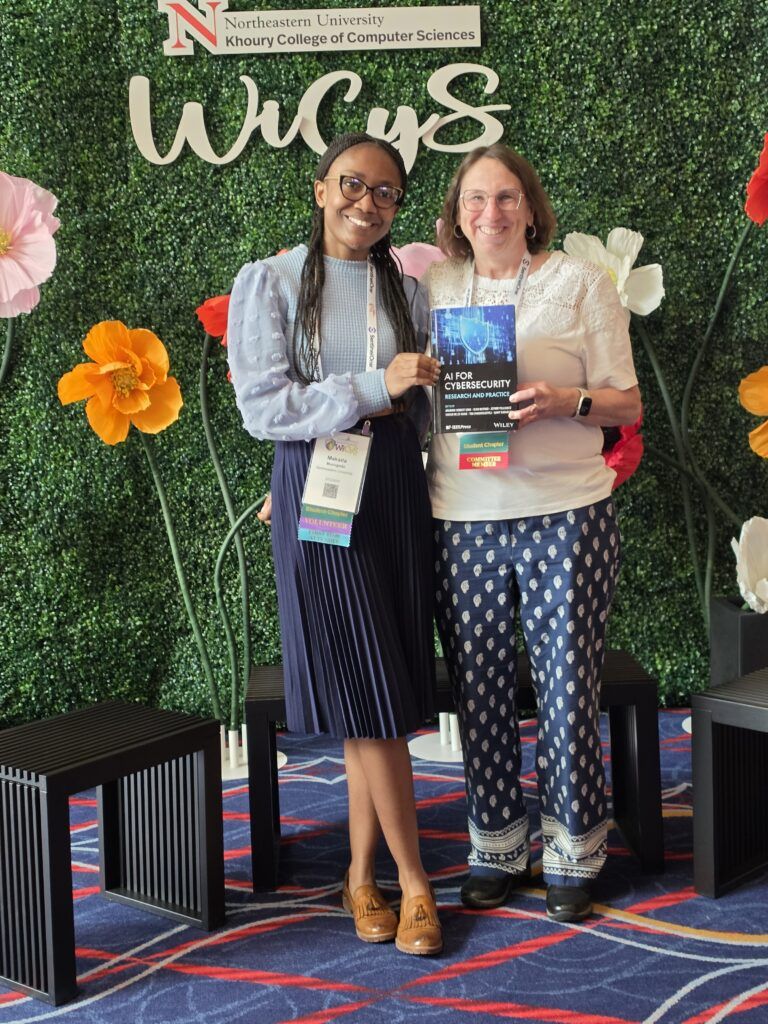
At the same time, Murogodo was applying for her first co-op, and she was delighted to find that Northeastern University’s connections and reputation opened doors. When she landed a 6-month position working in cybersecurity at Boston-based consulting services firm RSM, she credited Northeastern for the opportunity.
“When you apply, you want a university that is well known, that has a presence in the industry,” she said. “This co-op is an experience that I’m looking forward to, that I’m having because I’m here. Because people know Northeastern, they trust that you are capable.”
She also appreciated how much support the university had provided as she transitioned from a background in computer systems engineering into cybersecurity.
“Cybersecurity has been something really new, and these professors, they just made it easier. Dr. Hawthorne (especially) —she’s also part of WiCys, so she’s more like a mentor. You can ask her anything that you want. I have taken all her courses since the first semester. She’s been amazing.”
Murogodo hopes the growing community of women in cybersecurity will encourage others like her to take the plunge and go for the technical roles they really want. She also hopes that as the benefits of gender-diverse teams become increasingly clear, the practice of discriminating against female applicants will fade across the globe.
“If you’re a hiring manager, gender shouldn’t be the deciding factor,” she said. “Check on the skills – do I have the certifications? Am I competent?”
The answer, at Northeastern University in Arlington, is yes.