Hackathon Connects Policy & Tech Students to Help the Public Secure Vital Services
An interdisciplinary hackathon for social impact harnessed the value of students’ diverse areas of expertise.
News > Social Impact Hackathon
by Daniel Cohen
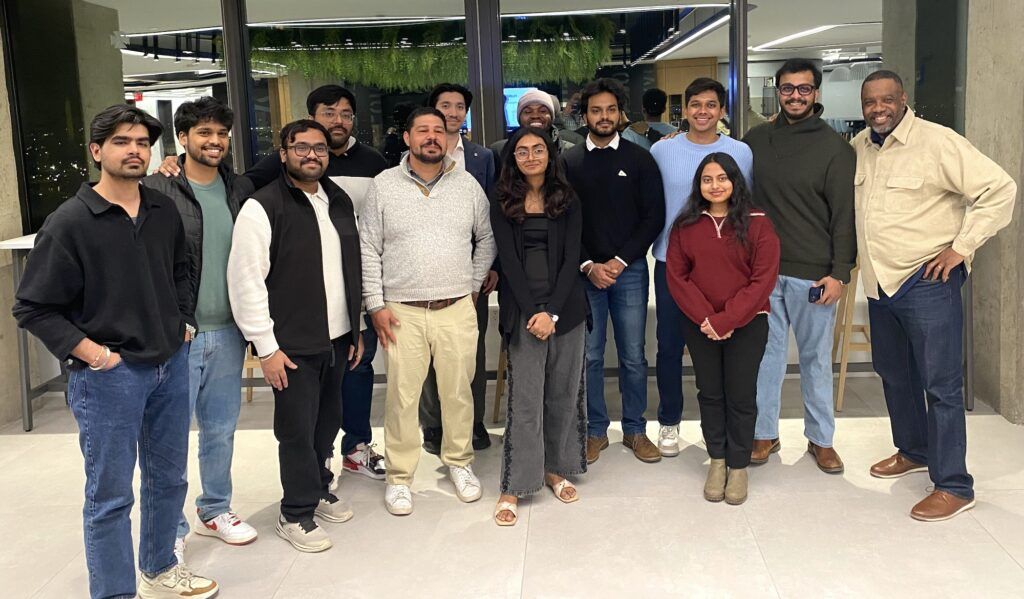
Two teams composed of students from three academic colleges on Northeastern University’s Arlington campus worked for 16 hours over two days in January to build prototype applications aimed at streamlining the process for local residents to obtain benefits from the community’s social safety net.
The campus’ tech and policy hackathon provided an opportunity for students at the College of Social Sciences and Humanities (CSSH) to collaborate with peers from the Khoury College of Computer Sciences, the College of Engineering and the College of Professional Studies on a real-world policy problem that could be addressed through technology. In November, CSSH students proposed three policy issues for the event, with students in the university’s technology programs voting to take on the problem of accessing social safety net services. The challenge facing the teams was to help Arlington residents seeking emergency shelter, food assistance or health care navigate the maze of eligibility criteria, application forms and documentation requests required under the existing system of federal, state and local programs.
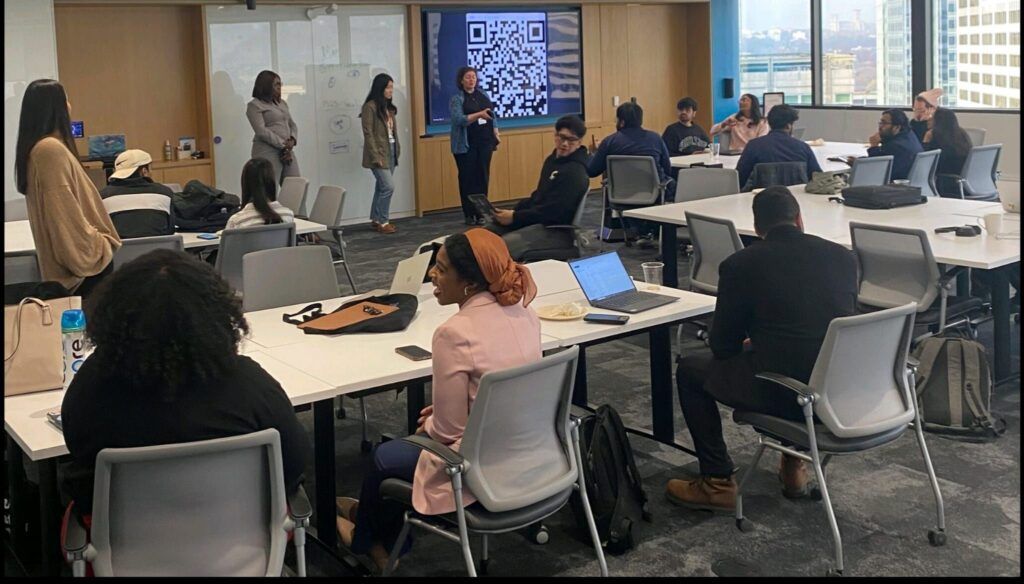
Photo courtesy Suchir Vangaveeti
The small teams received a detailed brief outlining the assignment a week in advance of the two-day hackathon but were only allowed to craft a brief design concept prior to the event. The teams were required to develop a technology interface that a resident could use to apply for social services and present their solution to a panel of judges, made up of Northeastern professors, representatives from tech firms and an Arlington County official.
By bringing together students from the campus’ four colleges, the hackathon reflected an ongoing programming goal. “One benefit of a small campus is it allows for cross-filtration,” said Dr. Marcia Mundt, an assistant professor in the School of Public Policy and Urban Affairs. “There’s a lot of value when you put those disciplines [policy and technology] together,” said Mundt, who organized the hackathon along with Dr. Elizabeth Hawthorne, professor and director of cybersecurity programs for Khoury College.
“I feel like we accomplished something that is almost impossible,” laughed Ruby Lo, a master’s student at Khoury, of the enthusiasm the event inspired across such a wide diversity of student interests. Lo represents Khoury as part of the university’s effort encouraging collaboration among students who are enrolled in different programs.
The event also was unique for being developed entirely by the campus team, rather than being hosted by a partner or sponsor. “This was built and developed solely by Northeastern,” said Tyler Leslie, an academic advisor and program manager for the College of Engineering.
Winning Team Stresses User Experience
The winning team built an app to help individuals overcome the multiple barriers — confusing forms, unclear eligibility requirements, overwhelming paperwork and long waits — to obtaining food assistance. Its prototype, FoodBridge, was designed to accommodate a broad range of applicant needs, including a lack of a high-speed internet connection, limited English language proficiency, and vulnerability due to trauma and other mental health challenges.
The team quickly realized the importance of focusing on the user experience rather than the underlying technology of its app after encountering its own challenges while applying for food assistance. “We are more tech savvy than the average person but still it found it difficult to access benefits,” said team member Pradhyumna Soni, a recent College of Engineering graduate. At a hackathon they typically would focus on the use of state-of-the-art tools, he said, but in this case, with a problem everyone could relate to, “the team aimed for a user-friendly solution more than a tech one.”
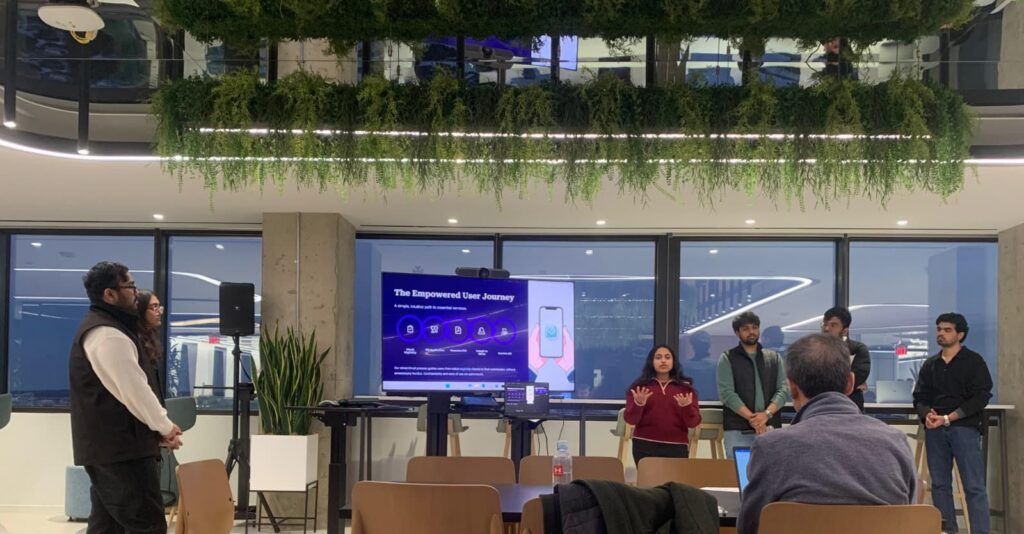
Photo courtesy Suchir Vangaveeti
The team opted for a phone-based app that used a unified intake form applicable to multiple benefit programs bridging local and state services. It provided audio descriptions for users with limited English proficiency. To alleviate security concerns, the system would retain an individual’s data for only six months unless the user opted to preserve it for longer.
“We made the app as human as possible,” Pradhyumna said.
The other team developed a platform to streamline the intake process to obtain housing benefits from local and state agencies. One OpenDoor application was intended for users who prefer to avoid online systems but prioritize immediate assistance and privacy. A second option required individuals to set up an account to store their personal data but offered long-term support.
The judges praised both teams’ efforts, highlighting the practical application of the two prototypes. “Everybody did an exceptional job. I was very impressed,” Kwame Gyamfi, a senior software engineer at SteerBridge, said after the panel voted 3-2 in favor of the FoodBridge app. “I really think my firm’s leadership would love to see these presentations. What I saw was an actual project that we are actually working on,” he said.
The Work Is the Prize
The FoodBridge team didn’t walk out with cash or a dream vacation, but they did win confirmation of their product and opportunities to pursue more growth. They were invited to dinner with the judges, who offered feedback on how the students can continue developing their prototype. Showcasing that they can build something effective with a team and under tight constraints, building out their portfolio, and expanding their network is the value that hackathons offer to students. “The work is the prize,” said Leslie.
One of the university’s goals for the hackathon was creating a “resume-worthy project” for Northeastern students. When a professional has added a new skillset, or is changing their career focus, portfolio pieces are an incredible asset as they market themselves to employers. And when the projects are created with an interdisciplinary team, the results are very relevant to hiring managers who are looking for evidence that a candidate can create good results with multiple stakeholders.
As a result of the hackathon’s success, it likely will become an annual event for the Arlington campus, said Mundt, one of the faculty who spearheaded the inaugural program. Several students already have volunteered to help organize it next year, she said.
The hackathon may also inspire an interdisciplinary course solving real-world problems for a local government agency or nonprofit. A class, which could include tech and public policy professors, would allow students to work on problems iteratively, in contrast to the one-off nature of a hackathon.
“I would be really curious if you turned that into a service-learning course, what would come of it,” Mundt said. “It would be amazing to offer such a learning opportunity in the future.”